
What does a babysitter earn in Italy? This guide covers up-to-date hourly rates, with real examples based on experience, contract type, live-in arrangements, and time of day.
If you work as a babysitter and want to know what to charge, you’re in the right place. Real rates for 2026 are here. On average, a babysitter in Italy earns around €9 per hour — but your actual pay can vary quite a bit depending on the city, your experience, and how many children you’re looking after. Some babysitters earn significantly more, especially in larger cities or with more experience under their belt. But what could you realistically earn working 20 hours a week?
In this guide, you’ll find the average babysitter salary in Italy, what you can expect to earn per hour, and when it makes sense to ask for more. If you’re a parent looking to hire a babysitter instead, check out our guide on how much a babysitter costs in 2026.
How much does a babysitter earn per hour?
As mentioned, the average hourly rate for a babysitter in Italy is €9.63, according to Sitly data. Of course, this is an average — your rate could be higher or lower depending on your situation.
A good starting point is the minimum rates set by Italian law. These give you a concrete reference so you don’t undersell your work. From there, personal and practical factors come into play: the city where you work, your skills, the age and number of children, the time of day (daytime or evening), and the type of working arrangement you have with the family.
The legal minimum for babysitting work
Babysitting falls under “domestic work” in Italy and is governed by the National Collective Labour Agreement for Domestic Work (CCNL Lavoro Domestico). This agreement sets different minimum rates based on skills and experience. For example, if you care for newborns or have specific childcare training, you can charge a higher hourly rate.
The contract levels are:
- Level BS (B Super): €7.45 gross/hour. For babysitters who look after older, self-sufficient children — playing with them, supervising, accompanying them to activities, or doing evening presence.
- Level CS (C Super): €8.30 gross/hour. For those who care for young children or children who aren’t yet self-sufficient.
- Level DS (D Super): €9.97 gross/hour. The rate for qualified babysitters or nannies with specific training or healthcare skills — for example, caring for newborns or children with disabilities.
On top of these figures, you should also factor in INPS social security contributions, a thirteenth-month salary (an extra month’s pay per year), and TFR (severance pay).
Babysitter salary table
| Level | Minimum hourly rate | Description |
|---|---|---|
| BS (B Super) | €7.45 | Babysitter caring for self-sufficient children: play, supervision, pick-ups, evening presence. |
| CS (C Super) | €8.30 | Babysitter/nanny caring for young or non-self-sufficient children: feeds, hygiene, basic educational tasks. |
| DS (D Super) | €9.97 | Babysitter/nanny with specific qualifications or healthcare skills, caring for newborns or children with special needs. |
Data updated as of 1 January 2026 — CCNL Lavoro Domestico.
Babysitter salary working 20 hours a week
So how much can you earn working part-time as a babysitter? Working 20 hours a week, you can expect to earn between €650 and €850 per month, depending on whether you care for very young children or have specific qualifications. The figure can also vary based on the city you work in, your experience, and the tasks involved.
Babysitter rates with the Libretto Famiglia
The minimum rates above apply when you work regularly with one family under an employment contract. But if you work occasionally for different families — maybe a couple of evenings a month so parents can have a night out, or you’re called in when children are sick — you can be paid through the INPS Libretto Famiglia system.
Each hour of work is worth €10: of this, €8 is your net pay, while the rest covers INPS contributions, INAIL insurance, and admin costs. The family logs the hours on the INPS website and you receive payment directly from INPS by the 15th of the following month.
Even for just a few hours, you’re covered by contributions and insurance. To use the system, you simply need to register online as an occasional worker, and the family does the same and loads up the necessary credit.
Example: Sara, 21, babysitter for 3 children including dinner
Sara is 21, has plenty of babysitting experience, and is studying to become a teacher. She also has a paediatric first aid certificate. Once a week, she works for a family with three children aged 8, 5, and 3. At 4pm she picks up the youngest from school, then the two older ones. Back home, it’s snack time and some playtime — and if the weather’s nice, she takes the children to the park nearby. Sara then cooks dinner and feeds the children before the parents get home from work around 7:30pm.
How much should Sara earn? Here’s how to calculate a fair hourly rate:
- €7.45/hour — minimum contract rate 2026 for Level BS (CCNL Lavoro Domestico)
- +€2.00/hour — supplement for managing two additional children (3 in total)
- +€1.00/hour — recognition for experience and paediatric first aid certification
Total: €10.45 per hour. For a 3.5-hour shift, that’s €36.50.
Hourly babysitter rates in major Italian cities
The minimum rates are important to know — they help you understand what fair pay looks like. But your actual rate is agreed directly between you and the family, and depends on many factors.
One of the biggest is location: hourly rates can vary significantly from city to city. A babysitter in Milan typically earns more than one in Naples on average — but it all depends on the job. If you’re in Naples caring for two young children or have a lot of experience, you could earn more than a first-time babysitter in Milan.
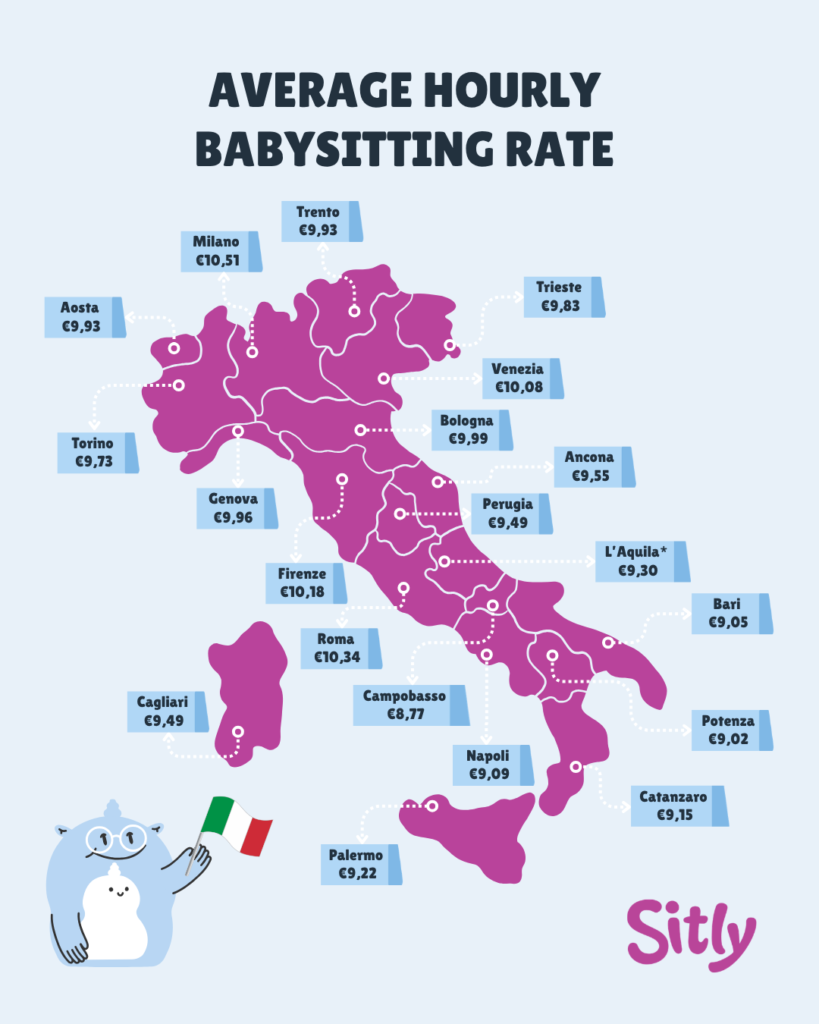
Hourly babysitter rates by city
| City | Hourly rate |
|---|---|
| Milan | €10.51 |
| Rome | €10.34 |
| Florence | €10.18 |
| Venice | €10.08 |
| Bologna | €9.99 |
| Genoa | €9.96 |
| Trento | €9.93 |
| Aosta | €9.93 |
| Turin | €9.73 |
| Trieste | €9.83 |
| Ancona | €9.55 |
| Cagliari | €9.49 |
| Perugia | €9.49 |
| L’Aquila | €9.30 |
| Palermo | €9.22 |
| Catanzaro | €9.15 |
| Naples | €9.09 |
| Bari | €9.05 |
| Potenza | €9.02 |
| Campobasso | €8.77 |
Average rates requested by babysitters registered on Sitly. Based on a database of over 350,000 babysitters.
Calculating your babysitter rate
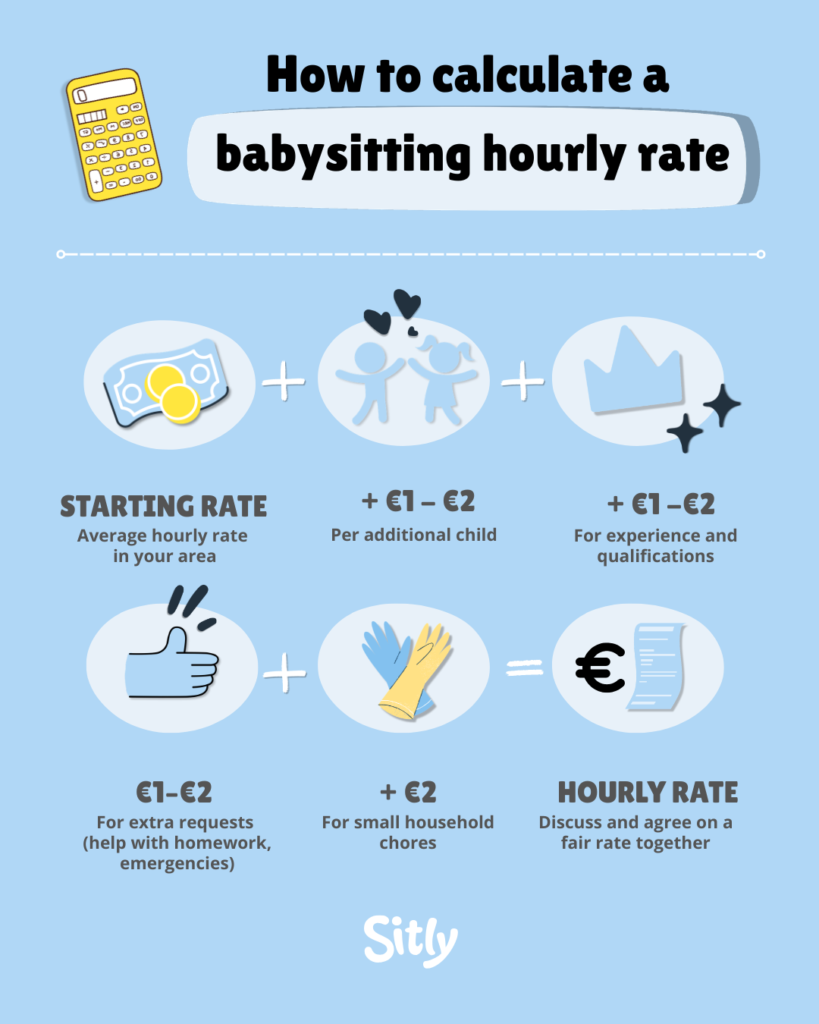
Alongside location, there are plenty of other factors that can help you earn more: your experience, qualifications, the number of children, any extra tasks you take on. All of these affect your hourly rate.
Use the Sitly calculator to quickly see average rates for babysitters in your area. Enter your city, the tasks involved, and the number of children to get an instant reference rate.
How much does an experienced or qualified babysitter earn?
If you’ve been working with children for years, or have specific training (such as childcare education, nursery nursing, social care, or early years qualifications), you can charge above the minimums. Families are generally happy to pay more when they see real professionalism, confidence, and educational skills.
How much does a babysitter earn per hour for two children?
When you’re looking after two or more children, your hourly rate can go up by 10–20% compared to the base rate, depending on the level of effort involved. Managing two young siblings, for example, takes considerably more attention than one older child. If the children are very different ages, finding activities that work for both can add another layer of complexity. Here are all our tips for babysitters looking after two children.
Hourly rate for babysitters with light household tasks
Tidying the children’s bedroom, making the children’s lunch, washing up the dishes the children used, or folding the children’s laundry are all standard babysitting tasks. But if you’re also asked to do general household chores — like hanging out the family’s washing, dusting, or vacuuming — these are extra duties and should be paid separately.
Babysitter rate when using your own car
Many babysitters pick children up from school and drop them off at swimming, dance, and other activities. If you use your own car for these trips, you can agree a flat monthly or weekly reimbursement with the family to cover fuel costs.
How much does a babysitter earn in the evening or overnight?
Evening babysitting generally pays a little more, since working at night means less convenient hours. As a rule of thumb, for evening work you can ask for 10–20% more than your daytime rate. So if you normally charge €8, you could ask for €9–€9.50 in the eveningm especially if you stay overnight or if you’re working past 10pm.
It also depends on what’s involved: if you arrive once the children have already eaten, they go to bed shortly after, and the night passes without a hitch, you might accept a slightly lower rate. If the children are very young or wake frequently and you need to be on hand throughout the night, it’s fair to ask for more.
A tip on safety: agree with the parents from the outset how you’ll get home safely after a late finish. Will they drop you off? Cover a taxi? Walk you to your car? Your safety matters and it should be a shared responsibility with the family.
Example: Giulia, 19, occasional evening babysitter
Giulia is 19 and a university student. She has two years of babysitting experience, starting with her younger brother and cousins, and works as an occasional babysitter on weekend evenings. When she arrives at 7:30pm, the children have already eaten. She puts them to bed around 8:30pm and stays until 11:30pm. The parents drop her home afterwards. During the evening, she’s asked to unload the dishwasher — apart from that, she can relax while the children sleep.
How much does Giulia earn?
Together with the parents, they agree on €8 per hour, reflecting the fact that the children go to bed early and the level of involvement is minimal.
Total for the evening: €8 × 4 hours = €32
Should you charge by the hour or a flat rate?
Better to be paid hourly or with a fixed monthly fee? It depends on the type of work you do for each family. For occasional jobs or work with variable hours, an hourly rate is better — you’re paid only for the hours you actually work.
If you work regularly with one family, a fixed monthly fee can be more convenient. In that case, it’s important to be clear from the start about what’s included. For example: if the family doesn’t need you one day, do you still get paid? If they ask you to stay two hours later unexpectedly, will those hours be paid separately? And if you normally work on Tuesdays but there are five Tuesdays in a given month, how is that handled?
Tip: sort out these details upfront to avoid misunderstandings and keep things professional and relaxed with the family.
Last-minute babysitting rates for emergencies
What if the family calls you at the last minute? Maybe early in the morning because a child has woken up with a fever. For last-minute call-outs, you can generally charge a higher rate (around 10–20% more). It’s worth agreeing on an “emergency rate” with the family in advance — one that applies whenever you’re asked to step in at short notice. That way everything is clear, and your flexibility is recognised and rewarded.
Example: Stella, occasional babysitter called in at the last minute
Stella has an arrangement with one family to be their back-up babysitter for morning emergencies. Lorenzo’s mum calls her at 6:45am — Lorenzo has a temperature and can’t go to nursery, and she has an important meeting at work. Stella arrives at 8am and stays until 1pm, when the grandmother takes over.
How much does Stella earn?
Here’s how to calculate a fair rate for this kind of situation:
- Base hourly rate (Level BS, minimum contract rate 2026): €7.45 gross/hour
- Last-minute/emergency supplement: usually around +20%, so approximately +€1.50/hour
- Total hourly rate: around €9/hour
For 5 hours (8am to 1pm), Stella earns €45.
How much does a babysitter earn per month?
Monthly earnings can vary a lot depending on hours worked and experience level. A part-time babysitter working around 20 hours a week can earn between €700 and €900 per month. If you work full-time and have qualifications or experience with newborns or children with specific needs, earnings can exceed €1,200 per month. Some nannies with broader responsibilities, or who live with the family (live-in), can earn more — though these are more structured working arrangements, governed by a formal contract with regular contributions.
How much does a babysitter earn per day?
If you work just for a few days at a time — during school holidays or while parents are away for work, for example — you can agree a daily rate instead of an hourly one. The calculation is straightforward: multiply your hourly rate by the hours actually worked. An 8-hour day is typically worth between €70 and €90 on average, though this can be higher if you’re caring for very young children, preparing meals, or staying into the evening.
Tip: agree with the family upfront what the hours will be, what you’ll be doing during the day, and how you’ll be paid if an unexpected situation means you need to stay longer than planned.
How to set your babysitting rate
To decide on your hourly rate, you need to weigh up several things: your qualifications and experience, the number and ages of the children, the average rate in your area, the time of day you work, and the responsibilities involved.
Once you’ve landed on a rate that feels right for you, the next step is to discuss it openly with the family. It can feel a bit awkward at first, but being upfront about pay from the very start is the best way to avoid misunderstandings and get the working relationship off on the right foot.
A good approach is to come prepared: research the going rates in your area, and during your meeting, calmly explain your rate and the reasons behind it — for example, the children’s ages, the hours, or any extra tasks. You can also ask the family what figure they had in mind: it turns the conversation into an open, transparent exchange, and makes it much easier to reach a fair agreement that works for everyone.
Table of contents


FAQ

In Italy, a babysitter earns on average between €7 and €10 per hour for occasional work. In larger cities like Milan, Rome, Florence, Bologna, and Turin, rates can rise to €10–12/hour thanks to higher demand.
Pay varies depending on:
- Experience and references
- The age and number of children being cared for
- City and area
- Additional tasks (homework help, cooking, light cleaning)
- Time of day (evenings, weekends, public holidays)
- Certifications (first aid, BLSD/CPR course, etc.)
Yes. It’s common to apply an increase for:
- Evenings: +€1–2/hour
- Weekends: +€2–3/hour
- Public holidays: up to +50% on the standard rate
Many families are happy to recognise the extra commitment that comes with less convenient hours.


Sitly: Connecting parents & sitters since 2012
In need of a helping hand with the kids, or are you looking for a job with children? Sitly helps parents and babysitters find the perfect match. Sign up, browse profiles, and start connecting today!
Related Articles

How much does a babysitter cost per hour? Real rates in 2026.
How much does a babysitter cost in Italy in 2026? The average rate is €9.63 per hour, but the price varies depending on experience, duties and city. Find out the minimum rates set by the national contract, the real costs including social contributions and the thirteenth-month payment, and how to calculate the right fee for your babysitter.

Put the Phone Away! 101 Fun Indoor Games to Play at Home
Looking for ways to have fun with kids at home? Here's a list of 101 creative and fun indoor activities—no fancy equipment needed! From movement games to crafts, dress-up, storytelling, and mini science experiments, these ideas are perfect for spending time together in a fun and imaginative way.