
How much does a babysitter cost in Italy in 2026? The average rate is €9.63 per hour, but the price varies depending on experience, duties and city. Find out the minimum rates set by the national contract, the real costs including social contributions and the thirteenth-month payment, and how to calculate the right fee for your babysitter.
How much does a babysitter cost per hour in Italy in 2026? The average rate is €9.63 per hour, but the cost can vary a great deal depending on the city, experience and number of children. The fee also changes based on the type of babysitter, the responsibilities involved and the hours (evenings, weekends or public holidays).
If you’re thinking of hiring a babysitter, this guide has up-to-date rates, the cost of a babysitter for two children, the minimum rates set by the national contract, and how to work out the right fee for your situation.
Are you a babysitter and want to know how much to charge? Read our guide on how much a babysitter earns in 2026.
How much does a babysitter cost? The legal minimums
To understand how much a babysitter costs, let’s start with the minimums set by law. Babysitting falls under “domestic work”, which is regulated by the National Collective Labour Agreement for domestic work (CCNL lavoro domestico). This sets minimum hourly rates based on skills, experience and duties. Rates start from a gross hourly minimum of €7.45 for babysitters carrying out basic tasks with no specific qualifications, up to €9.97 for qualified babysitters and nannies caring for newborns or children with special needs.
| Level | Minimum hourly rate | Description |
|---|---|---|
| BS (B Super) | €7.45 | Babysitter caring for self-sufficient children: play, supervision, school runs, evening presence. |
| CS (C Super) | €8.30 | Babysitter/nanny caring for young or non-self-sufficient children: feeding, hygiene, continuous supervision, basic educational tasks. |
| DS (D Super) | €9.97 | Highly qualified babysitter/nanny with specific qualifications or medical expertise: care of newborns, children with disabilities or special needs. |
Table of babysitter hourly rates under the CCNL lavoro domestico as of 1 January 2026.
On top of the rates shown in the table, you need to add:
- INPS social security contributions, which vary depending on hours worked and amount to approximately €1.50–2.00 extra per hour;
- the mandatory thirteenth-month payment, applicable to all domestic workers, which equals one extra month’s pay per year;
- severance pay (TFR) and accrued holiday entitlement.
In practice, a babysitter paid €7.45 gross per hour may actually cost €9–10 per hour once contributions and the additional monthly payment are factored in.
Paying your babysitter with the Libretto Famiglia
If you only need a babysitter occasionally — for example, to go out a few evenings — you don’t need a formal employment contract. In these cases, you can use the INPS Libretto Famiglia. It’s a tool designed specifically to pay for occasional services, such as babysitting, in a straightforward and compliant way.
Here’s how it works: each “voucher” is worth €10 for one hour of work and covers the babysitter’s pay, including social security contributions and INAIL insurance. You can buy the vouchers online and then log the hours worked directly on the INPS portal. It’s a simple way to manage payments while keeping everything above board, including insurance coverage.
Hourly rate or fixed fee: which should you choose?
The most common way to pay a babysitter is by the hour. It’s simple, clear and above all fair: you pay for exactly the time the babysitter spends with your children. This works well when you need flexible, irregular help — or cover at short notice.
That said, there are situations where a fixed rate (weekly or monthly) makes more sense, for both you and the babysitter. For example, if she comes every morning to take the children to school, or looks after them on the same evening every week. In cases like these, agreeing on a set fee makes budgeting and planning much easier.
Hourly rate or fixed fee: how to choose
Hourly babysitter rate: the best option if you need flexible cover. For instance, if you don’t always finish work at the same time, often need extra help, or sometimes ask the babysitter to take on additional tasks. With an hourly rate, you pay for exactly the time she spends with your children, and she’ll be more willing to be flexible when something unexpected comes up.
Fixed or flat-rate babysitter fee: more convenient when the babysitter’s hours are regular (for example, every Saturday evening) and her duties are clearly defined. It makes budgeting easier for you, and gives the babysitter a reliable income each week or month.
Things to keep in mind with a flat rate:
- Be clear about what’s included (for example, how many children she’ll be caring for, whether light household tasks are expected, and whether you’ll reimburse travel costs if she takes the children to activities).
- Consider a bonus or extra payment if something unexpected comes up (such as staying later than planned or taking on additional tasks).
- Bear in mind that with a flat rate, the effective hourly rate may be slightly lower — but you’re still committed to paying it. For example, if one Saturday evening you decide to stay home and don’t need the babysitter who usually comes every week, you’ll still need to pay the agreed fee. That’s part of the arrangement.
For example: you might agree on a fixed €40 for a regular five-hour evening, during which the children go to bed early and the babysitter has nothing to do while they sleep. But if you ask her to arrive a bit earlier, cook dinner, or stay later than usual, it’s fair to add a supplement calculated at an hourly rate.
How much do you pay a babysitter for 2 children?
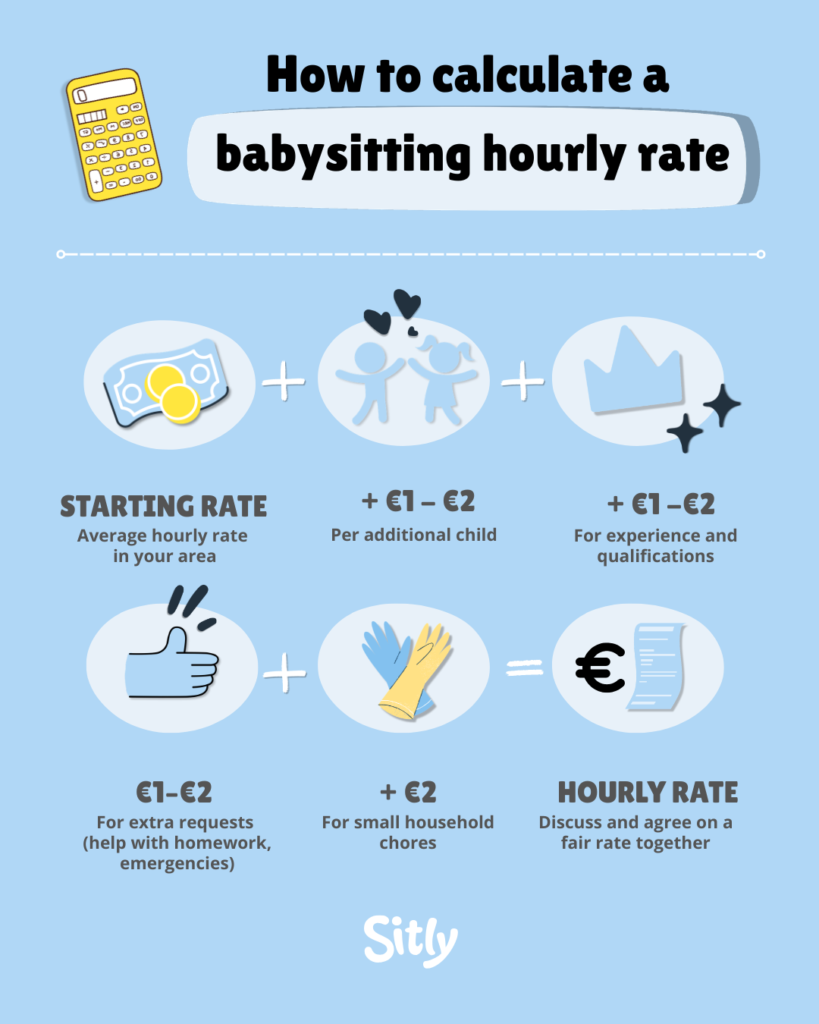
For two children, the hourly rate generally goes up by €1.50–2.50 compared to the base rate, depending on the children’s ages and the level of effort involved. Looking after two or three children at the same time requires significantly more energy and attention than caring for one. It’s only fair to reflect that in the pay.
Try the Sitly calculator to get an idea of what to pay a babysitter for two children, based on average rates in your area. Enter your city and the number of children to see a suggested rate straight away.
Example babysitter cost in Rome: 19 years old, 3 children, cooks dinner
Sara is 19, has plenty of babysitting experience and has just started a teacher training course. She also holds a paediatric first aid certificate. Once a week she works for a family with three children aged 8, 5 and 3. At 4pm she picks up the youngest from school, then the two older ones. They head home for a snack and some playtime. When the weather’s nice, she takes the children to the park near the school. Sara then cooks dinner and feeds the children before the parents get home from work around 7.30pm.
How much should Sara earn? Here’s how to work out a fair hourly rate:
- €7.45/hr = 2026 minimum contractual rate for a BS-level babysitter (CCNL lavoro domestico)
- + €2.00/hr = supplement for managing two additional children (3 in total)
- + €1.00/hr = recognition of experience and paediatric first aid certification
Total: €10.45 per hour. For 3.5 hours, Sara earns €36.
Babysitter hourly rate: children’s ages
The age of your children matters when deciding how much to pay your babysitter.
Newborns and very young children require constant, uninterrupted attention. The babysitter needs to be alert and ready to step in at all times. That’s why the CCNL for domestic work sets a higher minimum rate for babysitters caring for newborns.
With children aged 6 and over, things get easier. They eat independently, use the bathroom on their own and can often keep themselves entertained, which reduces the demands on the babysitter.
The younger and more dependent the children, the more energy and responsibility the role requires — and the rate should reflect that.
Babysitter pay for light household tasks
Some small tasks are a natural part of babysitting: tidying the bedroom after playtime, making the child’s dinner, or washing up the plates used at mealtimes. But if you’d like your babysitter to help with additional light housework that falls outside her usual duties, you should pay a higher rate.
The kinds of extra tasks you might ask your babysitter to help with include:
- loading or unloading the dishwasher
- collecting and hanging out the laundry
- washing up
- cooking dinner
- vacuuming
- dusting
Keep in mind that you’re asking for something beyond her normal babysitting duties. Given that a domestic worker in Italy earns an average of €9–10 per hour, if your babysitter also helps around the house, it’s absolutely fair to pay a supplement on top of the base babysitting rate.
Daytime vs evening babysitter rates
Occasional evening babysitting generally costs more than daytime care, though the rate can vary quite a bit depending on what’s involved. If the babysitter simply needs to be present while the children sleep through the night, the cost is usually lower. But if she also needs to cook dinner, feed younger children, give them a bath and put them to bed, it makes sense to agree on a higher hourly rate or a fixed evening fee that accounts for the extra work involved.
Everything can be agreed in advance with the babysitter, adapting the pay to fit your family’s needs.
Example: Giulia, 19, occasional evening babysitter
Giulia is 19 and a university student. She has two years of babysitting experience, starting with her younger brother and cousins. She babysits occasionally on weekend evenings. When she arrives at 7.30pm, the children have already eaten. She puts them to bed around 8.30pm and stays until 11.30pm, after which the parents drop her home. During the evening, they only ask her to unload the dishwasher; otherwise, she can relax while the children sleep.
How much does Giulia earn? Together with the parents, they agree on €8 per hour — a rate that reflects the fact that the children go to bed early and the workload is minimal.
Evening total €8 × 4 hours = €32
Giulia is happy with the arrangement and considers the rate fair. The parents are satisfied too, knowing they’ve set a clear rate that’s proportionate to the situation.
Last-minute babysitter rates for emergencies
Need a babysitter at short notice? That flexibility comes at a cost. Last-minute calls often mean the babysitter has to give up personal plans or rearrange her whole day — especially if she’s a student. In these cases, it’s fair to pay a higher hourly rate: immediate availability is a convenience for you, and flexibility should always be compensated fairly.
Example: Stella, an occasional babysitter called at the last minute
Stella has an agreement with a family to be their on-call babysitter for morning emergencies. Lorenzo’s mum calls her at 6.45am because Lorenzo has a temperature and can’t go to nursery, and she has an important meeting at work. Stella arrives at 8am and stays with Lorenzo until 1pm, when his grandmother takes over.
How much does Stella earn? Here’s how to calculate a fair hourly rate for this situation:
- Base hourly rate (BS level, 2026 minimum): €7.45 gross/hr
- Last-minute/emergency supplement: usually around +20%, so approximately +€1.50/hr
- Total hourly rate: approximately €9/hr
If the babysitter stays for 5 hours, from 8am to 1pm, the total cost will be: €9 × 5 hours = €45
Stella feels valued for her flexibility, and the parents know they can count on her in emergencies.
Agree on the rate together
Once you’ve worked out what a fair hourly rate looks like, the next step is to talk it through openly with your babysitter. These conversations can feel a little awkward, but sorting everything out from the start prevents misunderstandings later on.
Tip: ask the babysitter whether she already has a rate in mind. If you both come prepared, with clear expectations and the reasoning behind them, it’s much easier to reach an agreement that works for both of you.
Babysitter hourly rates in Italy
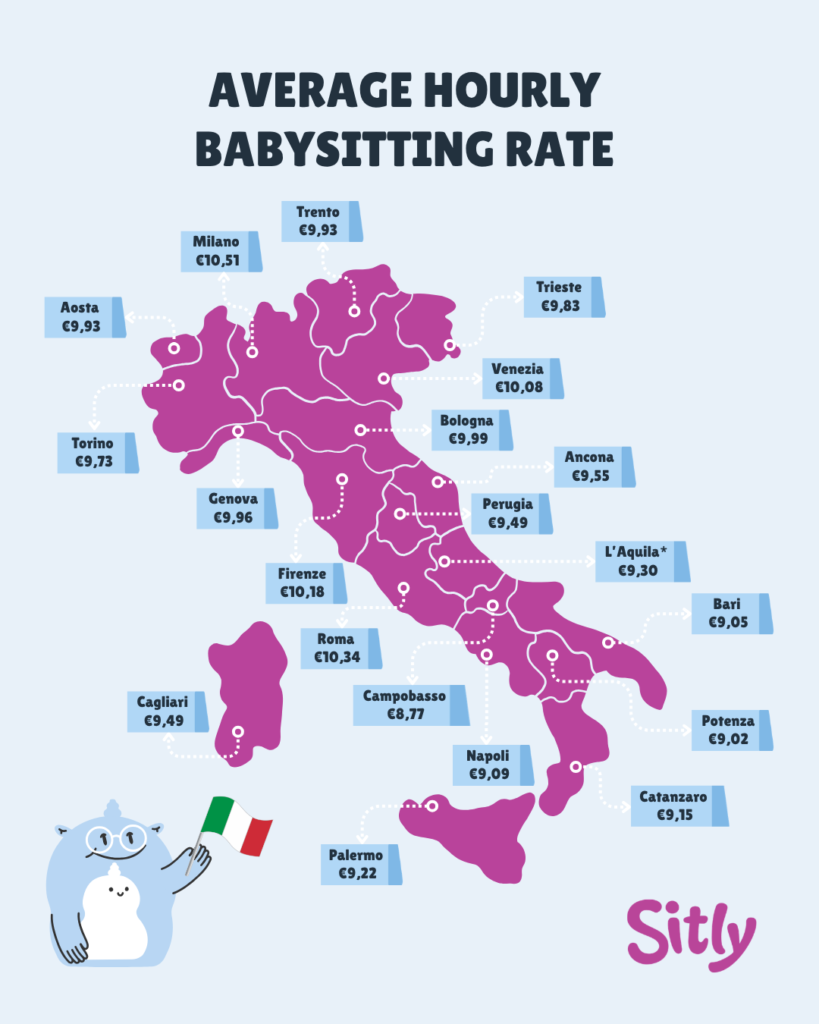
These figures are based on the average rates requested by the 350,000+ babysitters registered on Sitly in Italy. As the data shows, the national average babysitter rate is €9.63 per hour, but there are some interesting differences across Italian cities. In Milan and Rome, a babysitter costs over €10 per hour, while rates in the South remain lower: in Naples the average is €9.09, in Bari €9.05, and in Campobasso it drops to €8.77.
That said, finding a qualified babysitter in Naples doesn’t necessarily cost less than in Milan. A nanny with specific experience — for example in newborn care or with a paediatric first aid certificate — may charge above the average even in southern cities.
In short: averages are a useful starting point, but the real cost of a babysitter always depends on the factors that matter most — skills, availability and duties — as well as where you live.
Why do babysitter rates vary from city to city?
As the data shows, babysitter rates can vary considerably from one city to another, mainly due to supply and demand:
- In areas where there are many babysitters available and fewer families looking, prices tend to be lower.
- Conversely, where there are many families searching but fewer babysitters, prices go up.
To get a sense of the going rate in your area, it’s always worth asking friends, neighbours or other parents what they pay their babysitter. That will give you a more realistic picture of the right hourly rate in your city, taking into account your babysitter’s experience and qualifications.
Babysitter hourly rates across Italy
| City | Hourly rate |
|---|---|
| Milan | €10.51 |
| Trento | €9.93 |
| Aosta | €9.93 |
| Turin | €9.73 |
| Genoa | €9.96 |
| Florence | €10.18 |
| Cagliari | €9.49 |
| Palermo | €9.22 |
| Naples | €9.09 |
| Campobasso | €8.77 |
| Rome | €10.34 |
| Perugia | €9.49 |
| Bologna | €9.99 |
| Venice | €10.08 |
| Trieste | €9.83 |
| Ancona | €9.55 |
| L’Aquila | €9.30 |
| Bari | €9.05 |
| Potenza | €9.02 |
| Catanzaro | €9.15 |
Average rates requested by babysitters registered on Sitly. Over 350,000 babysitters.
So, how much does a babysitter cost?
There’s no single answer to the question of how much a babysitter charges. The right figure depends on a range of factors, including:
- the babysitter’s age, experience and qualifications
- the number and age of your children
- any additional tasks
- whether you need help during the day, in the evening or overnight
- the city where you live
- and, of course, your budget
Ultimately, it’s about finding the right balance between the babysitter’s expectation of fair pay and your family’s needs and means. The most important thing is communication: talk openly with your babysitter about your expectations, the tasks involved and the rate. Together, you’ll be able to reach an agreement that works for everyone.
Table of contents


FAQ

A babysitter costs on average between €9 and €12 per hour, but in larger cities like Milan or Rome rates can reach €13–15 per hour, particularly for the care of young children or evening hours. In smaller cities, the average is closer to €8–10.
A babysitter earns on average between €900 and €1,300 per month, depending on weekly hours, experience, and responsibilities. Nannies with a background in education or foreign languages can earn €1,500–1,700 per month, especially in families with young children or multiple children.
In Milan and Rome, a babysitter costs on average between €10 and €14 per hour. In central areas, or for experienced babysitters, families often offer €15–16 per hour. In outer neighbourhoods or for occasional work, rates tend to drop to around €9–10.


Sitly: Connecting parents & sitters since 2012
In need of a helping hand with the kids, or are you looking for a job with children? Sitly helps parents and babysitters find the perfect match. Sign up, browse profiles, and start connecting today!
Related Articles
How much does a babysitter earn in Italy? Real rates for 2026
What does a babysitter earn in Italy? This guide covers up-to-date hourly rates, with real examples based on experience, contract type, live-in arrangements, and time of day.

Put the Phone Away! 101 Fun Indoor Games to Play at Home
Looking for ways to have fun with kids at home? Here's a list of 101 creative and fun indoor activities—no fancy equipment needed! From movement games to crafts, dress-up, storytelling, and mini science experiments, these ideas are perfect for spending time together in a fun and imaginative way.